


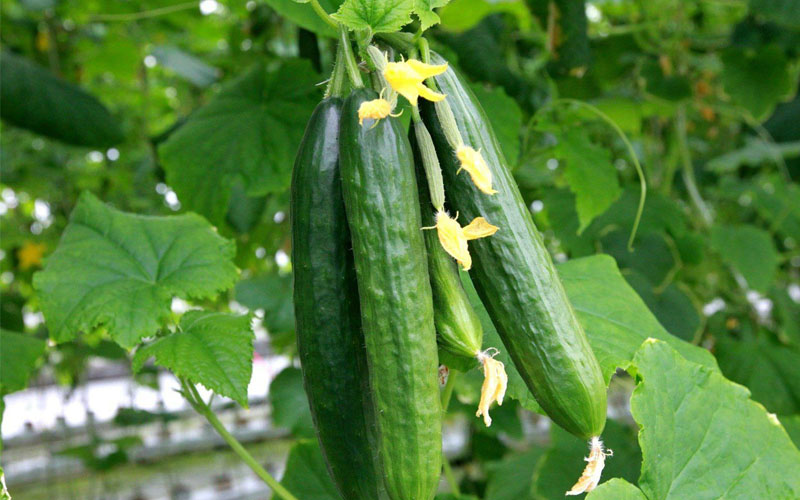
Cucumbers commonly show symptoms of nutrient deficiencies such as stunted growth, yellowing or browning of leaf margins, interveinal chlorosis, and malformed or poorly developed fruits; nitrogen deficiency typically causes older leaves to turn pale yellow and growth to slow; potassium deficiency manifests as yellowing and scorching of leaf edges with abnormal fruit development; magnesium deficiency results in yellow-brown interveinal discoloration and leaf scorch; calcium deficiency results in leaf edge necrosis and blossom end rot in fruits; and other deficiencies—including phosphorus, manganese, zinc, and boron—cause various symptoms such as dark green or mottled leaves, leaf end rot, corky fruit, and smaller, wavy leaves, all of which significantly impact cucumber yield and quality if not corrected with proper nutrient management.
Macro-N (nitrogen) deficiency
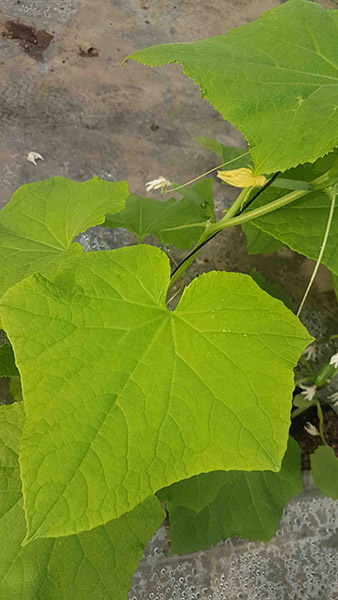
Nitrogen deficiency in cucumbers is characterized by pale, slender, stunted plants, in which the oldest leaves turn yellow while the new leaves remain small and green. As the deficiency progresses, the yellowing spreads upward to the younger leaves and fruit production is severely reduced, often resulting in pale, short, thick cucumbers with misshapen shapes and poor quality. Providing nitrogen through soil application or foliar spray can quickly correct the deficiency and restore healthy plant growth.
Kimat’s proposed solution:
Macro-P (phosphorus) deficiency
Phosphorus deficiency in cucumber is characterized by stunted growth, poor root development, dark, dull, and gray-green leaves, with the oldest leaves at the base turning light yellow while the upper leaves remain dark green; as the deficiency progresses, brown spots appear between the veins and the foliage generally turns yellowish-green, leading to reduced fruit formation and yield, so prompt identification and correction are essential to restore healthy growth.
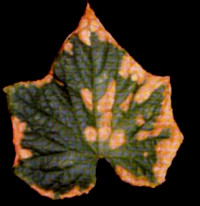
Kimat’s proposed solution:
Macro-K (Potassium) deficiency
Potassium deficiency in cucumber usually first appears in older leaves as yellowing (chlorosis) at the leaf margins and progresses to interveinal chlorosis, leaf edge scorching and ultimately necrosis, while the midrib and veins often remain green; as the deficiency worsens, leaves may become twisted or wrinkled, fruit development becomes abnormal with brown spots or spongy texture, and plants are stunted and exhibit shorter internodes, so early identification and immediate application of soluble potassium fertilizers are essential for healthy growth and yield.
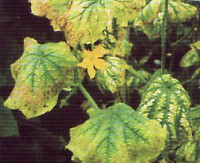 |
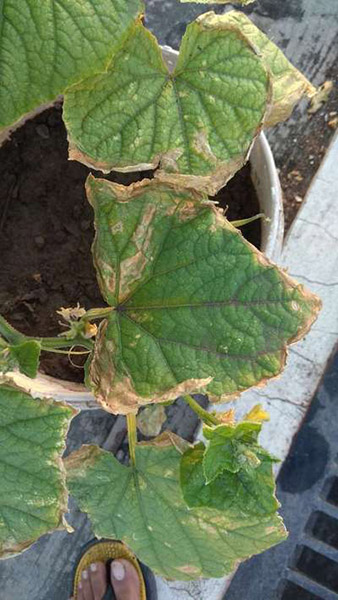 |
Kimat’s proposed solution:
Secondary macronutrient deficiency – Magnesium (Mg)
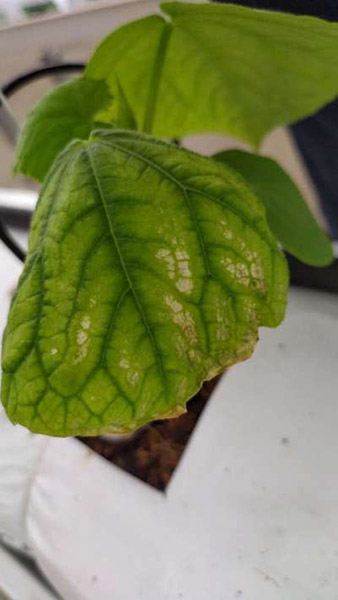
Magnesium deficiency in cucumber is characterized by yellowing between the veins of older leaves that retain narrow green margins; as magnesium deficiency progresses, these interveinal areas may develop a light tan or yellow-brown burn with symptoms of leaf edge burn, reduced fruit yield, and sometimes brittle or curled-up leaves. This is often caused by excess potassium, calcium, or ammonium fertilizers, cold or wet soils, or acidic conditions, and can be effectively managed with foliar sprays or soil applications of fertilizers containing magnesium.
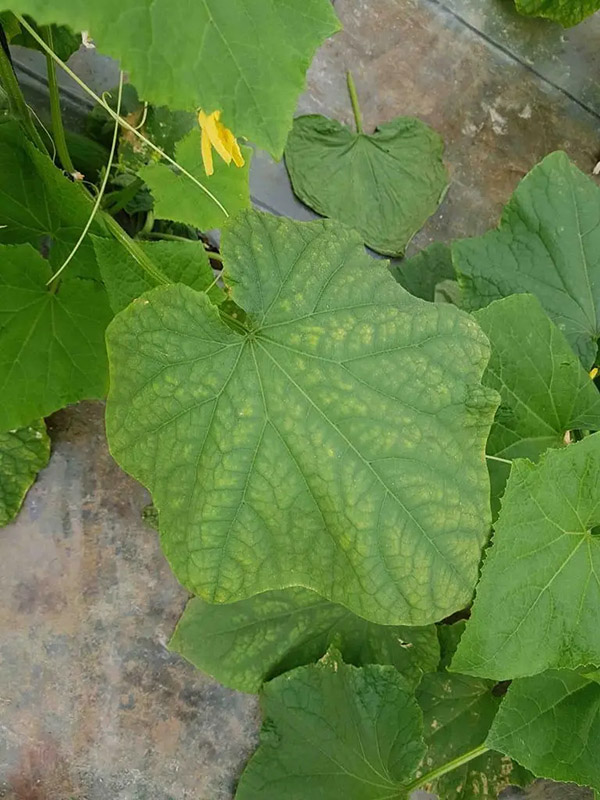 |
 |
Kimat’s proposed solution:
Secondary macronutrient deficiency – Calcium (Ca)
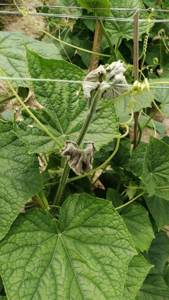
Calcium deficiency in cucumbers primarily affects new, actively growing leaves and shoots, causing them to cup downward, wrinkle, or show “burnt” edges, and sometimes small white spots may appear on the leaf surface; meanwhile, root tips and growing points can turn brown and die, and one of the most obvious symptoms is blossom end rot – burnt, sunken spots at the end of the fruit blossom that turn brown or black as the deficiency progresses, all of which can be caused by poor calcium uptake due to water stress, excess moisture, root damage, unbalanced fertilization, or pH problems, rather than simply a lack of calcium in the soil.
Kimat’s proposed solution:
Micro-element deficiency – Fe (iron)
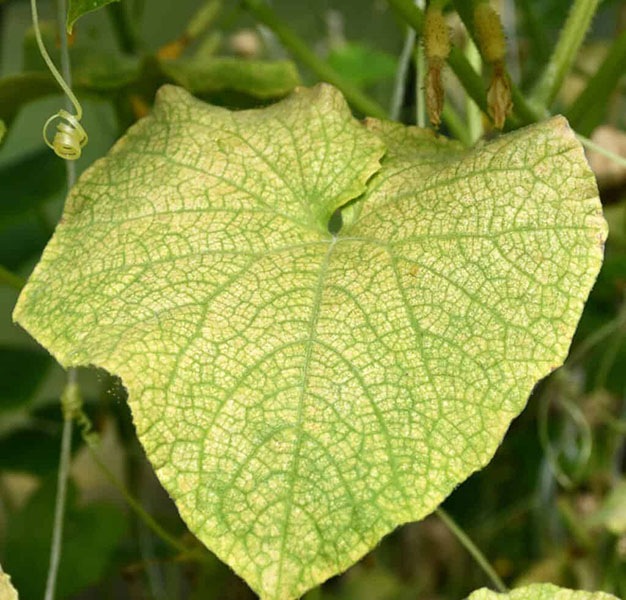
Iron deficiency in cucumbers begins with chlorosis or a uniform pale green color, starting with the youngest and newest leaves, while older leaves remain dark green. Initially, the veins remain green, creating a net-like pattern, but in severe cases of iron deficiency, even the small veins fade and the leaves may turn yellow to white and eventually burn, especially in strong sunlight. This deficiency is caused by iron deficiency, which is usually caused by alkaline or calcareous soils, high pH (above 7), excessive lime, poor drainage, or high concentrations of metal ions in the soil, which disrupts chlorophyll production and stunts plant growth.
Kimat’s proposed solution:
Micro-element deficiency – Mn (manganese)
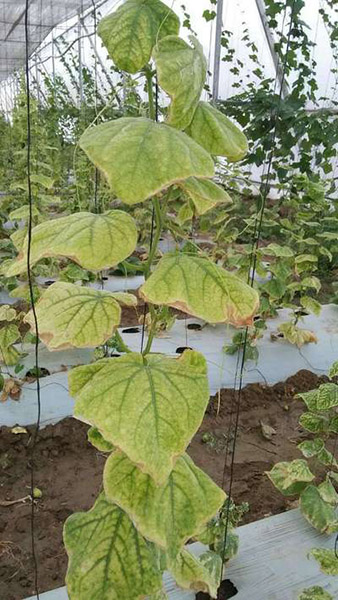
Manganese deficiency in cucumbers appears as mottled yellow-green spots between the leaf veins, often with more prominent scorched spots on the leaf edges than in normal plants. The deficiency primarily affects younger leaves, causing stunted growth, and the leaves may also show pale green to yellow chlorosis that highlights the veins and is sometimes accompanied by brown spots, while severe deficiency can result in shriveling or curling of the leaf margins and reduced shoot growth. This condition usually occurs in soils with high pH or poor drainage where manganese availability is limited.
Kimat’s proposed solution:
Deficiency of microelements – Cu (copper)
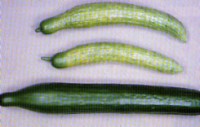
Copper deficiency in cucumber causes stunted growth with smaller leaves, often accompanied by leaves that are yellowish-green in color, especially on the lower leaves. In some cases, the mesophyll around the main veins remains green for a longer period of time, unlike the yellow veins. Severe deficiency results in yellowing of the entire plant, while the cotyledons and lower leaves die and the younger leaves stop growing. Fruits may be short, thick, pale or grayish-green with abnormal shapes. Copper is essential for photosynthesis, enzyme activation, and lignin formation, so its deficiency can reduce photosynthetic capacity, impair growth, and increase susceptibility to diseases.
Kimat’s proposed solution:
Micro-element deficiency – Mo (molybdenum)
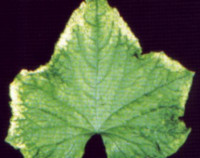
Molybdenum deficiency in cucumber usually causes pale green leaves to yellowing between the veins, progressing to necrosis of the leaf margins and stunting and deformity. The crown leaves are often affected around the time the plants begin to grow, and symptoms spread along the growing stems until the entire plant is affected, resulting in poor fruit set or even plant death. This deficiency is more common in acidic soils (pH below 6.0).
Kimat’s proposed solution: