


A nutritional program for watermelon is very important because it ensures optimal nutrient supply, strong growth, healthy fruit development, high yield and disease resistance, while nutrient deficiencies can lead to stunted plant growth, fruit malformation, reduced harvest quality and economic losses. Watermelon and cantaloupe are particularly sensitive to imbalances in nutrients such as nitrogen, potassium, calcium and boron. Improper management can cause certain disorders including fruit rot, fruit hollowing, low sweetness and reduced shelf life. By following a tailored nutritional program, farmers can match the nutrient levels to the plant’s needs throughout its growth stages, maximizing productivity and maintaining fruit quality for market success.
Macro-N (nitrogen) deficiency
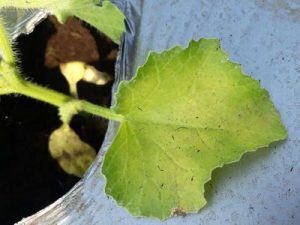
Nitrogen deficiency in both watermelon and cantaloupe causes lower or older leaves to turn pale green or yellow, plant growth is significantly stunted, and leaves are likely to yellow and drop prematurely. Plants appear smaller and paler, and their stems or vines become thin, stiff, and fibrous. Fruit formation and maturation are negatively affected – flowers are likely to abort, fewer fruits develop, and those that do develop are often small, pale, and sometimes misshapen. These symptoms result in reduced yield and poor fruit quality. Timely and balanced nitrogen applications prior to flowering are essential to prevent irreversible yield reduction and fruit defects in both crops.
Kimat’s proposed solution:
Macro-P (phosphorus) deficiency
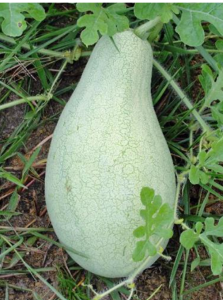
Phosphorus deficiency in watermelons and cantaloupes causes plants to stunt growth and leaves to turn a dull, dark green color, often with a purple discoloration on the undersides of leaves and petioles. Severe phosphorus deficiency may result in brown spots, rotting of older leaves, and delayed fruit ripening. Plants may also exhibit irregularly shaped fruit with a dull or bronze color and reduced fruit size. Symptoms are often subtle and are best detected through soil and tissue testing, as visual symptoms can be confused with other conditions. Ensuring adequate phosphorus before flowering and during the early stages of growth is critical for high yield, early maturity, and good fruit quality.
Kimat’s proposed solution:
Macro-K (Potassium) deficiency
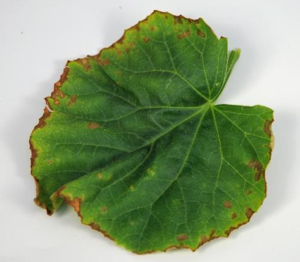
Potassium deficiency in watermelon and cantaloupe primarily affects older leaves, causing yellowing or marginal chlorosis that leads to browning or scorching along the leaf edges. Leaves may curl or shrivel, and in severe cases, leaf tips dry out. Plants are stunted, have weak stems, and are less resistant to diseases and environmental stresses. Fruit development is impaired, resulting in smaller, misshapen fruits with poor flavor and texture, and a higher rate of fruit cracking or splitting. This deficiency also reduces photosynthetic efficiency and overall yield. Managing potassium levels through proper soil testing and balanced fertilization is essential to maintaining healthy plant growth, fruit quality, and yield in both watermelon and cantaloupe crops. Additionally, potassium uptake can be affected by soil pH, nitrogen levels, and environmental stresses, so integrated nutrient management is recommended to prevent this imbalance. Continuous monitoring and adjustment of potassium supply improves plant vigor and the production of marketable fruit.
Kimat’s proposed solution:
Secondary macronutrient deficiency – Magnesium (Mg)
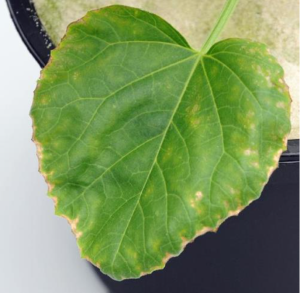
Magnesium deficiency in watermelon and cantaloupe usually begins with yellowing between the veins on older leaves while the veins themselves remain green. As the deficiency progresses, the yellowed tissue may turn white and eventually necrotic, leading to leaf damage and reduced photosynthesis. This deficiency is more common in acidic or sandy soils and can be exacerbated by excessive levels of competing cations such as potassium, calcium or ammonium, which inhibit magnesium uptake. Magnesium is essential for chlorophyll production and enzyme activation, so its deficiency results in stunted growth and significant reduction in fruit yield. Symptoms can be confused with manganese toxicity or fungal diseases, so accurate diagnosis is important.
Kimat’s proposed solution:
Secondary macronutrient deficiency – Calcium (Ca)
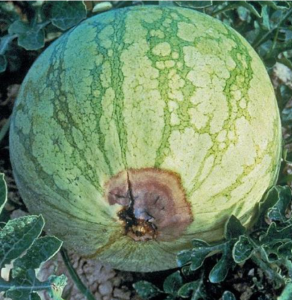
Calcium deficiency in watermelons and cantaloupes causes a range of serious symptoms, including malformed, scalloped leaves with weak veins, chlorosis starting at the leaf margins, and yellowing of younger leaves with green veins. Growing points and roots can die, and stems become weak and prone to cracking due to poor cell strength. This deficiency often results in blossom end rot, characterized by wet, dark, leathery lesions at the end of the fruit blossom, fruit cracking, hollowing of the core, and browning of the interior flesh, which can become watery. These symptoms sometimes only appear after harvest during transport or storage. Melons are particularly susceptible to calcium deficiency, which is exacerbated by uneven water supply, unbalanced potassium nutrition, acidic or sandy soils, and drought conditions. Adequate calcium supply through balanced fertilization and continuous soil moisture management is crucial to prevent these disorders and ensure fruit quality and yield.
Kimat’s proposed solution:
Secondary macronutrient deficiency – sulfur (S)
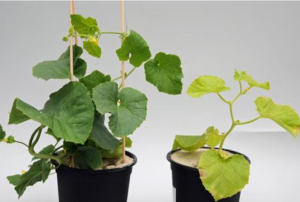
Sulfur deficiency in watermelon and cantaloupe causes general stunting of growth and a pale yellow to light green coloration of younger leaves, which distinguishes it from nitrogen deficiency, which first appears in older leaves. Affected leaves may also show small, sunken spots and light brown spots along the margins. Sulfur is essential for protein synthesis and chlorophyll production, so its deficiency compromises overall plant growth, delays maturation, reduces sugar content, and may increase susceptibility to diseases and environmental stresses.
Kimat’s proposed solution:
Micro-element deficiency – Mn (manganese)
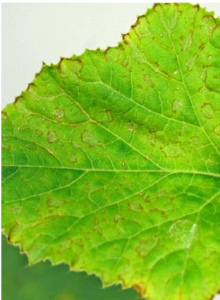
Manganese deficiency in watermelon and cantaloupe manifests as interveinal chlorosis in older leaves, where the tissue between the veins turns pale or yellow while the veins remain green. In severe cases, necrotic brown spots can appear on the leaf surface, and purplish-brown spots may develop on the stem or petiole of the leaf. Symptoms often begin on the leaf margins and may be accompanied by stunted growth, leaf curling, and in severe deficiencies, the tips of the youngest leaves can become white, tubular, and twisted, leading to stunted plant growth and possibly death of the growing point. High soil pH, calcareous soils, sandy soils, and organic matter-rich soils with high levels of phosphate, calcium, iron, or zinc can inhibit manganese availability and lead to deficiency. Remedial measures include foliar application of manganese sulfate and soil pH management to optimize manganese availability.
Kimat’s proposed solution: