



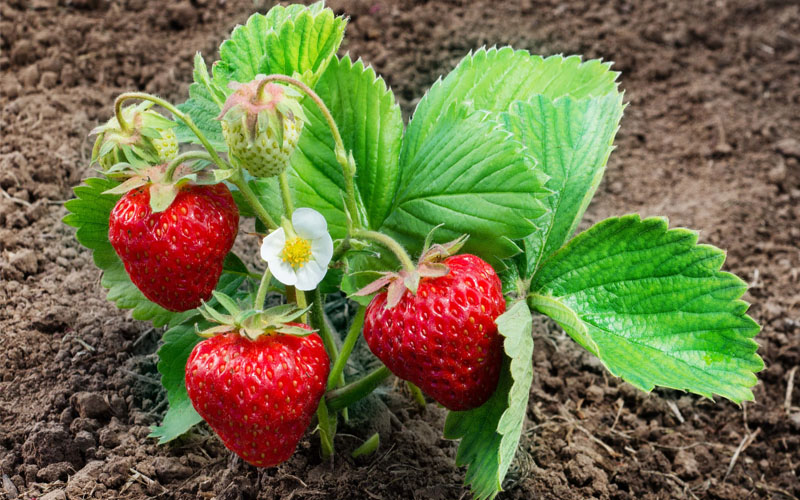
Nutrient deficiencies in strawberry plants are of great importance as they directly limit growth, fruit quality, yield and stress resistance, causing significant economic losses to growers. Deficiencies of key nutrients such as calcium, sulphur, zinc and copper negatively affect berry formation, plant metabolism and disease resistance, which can reduce productivity and marketability. Proper nutrient management is essential to maintain balanced leaf nutrient levels, optimise photosynthesis, improve fruit size and quality and ultimately ensure profitable and sustainable strawberry production.
Macro-N (nitrogen) deficiency
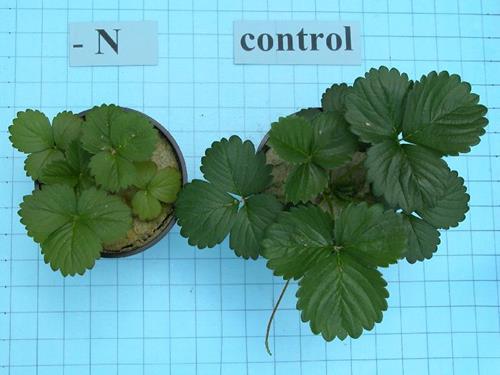
Nitrogen deficiency in strawberries is characterized by yellowing and light greening of the leaves, primarily affecting the middle-aged leaves while the newer leaves remain greener. As the deficiency progresses, the leaf petioles become short, red, and brittle, and overall growth is stunted and shoot production is reduced. Older leaves may show reddish margins, and plant vigor and fruit yield are reduced. Careful sampling of mature leaf tissue is important for diagnosis, as visual symptoms can overlap with other nutrient deficiencies or stresses. Proper nitrogen management is critical because both deficiency and excess can affect plant health and fruit quality.
Kimat’s proposed solution:
Macro-P (phosphorus) deficiency
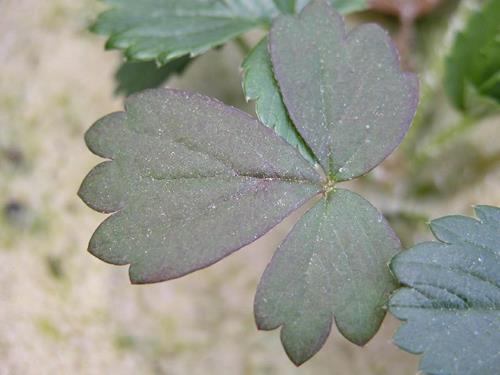
Phosphorus deficiency in strawberries is characterized by the growth of smaller, dark green or bluish-purple leaves, reduced leaf size, and poor root growth, with older foliage often exhibiting a reddish or purple color, especially in cold or high pH soils; plants deficient in phosphorus tend to produce stunted growth, fewer and smaller fruits, and necrosis may begin at the tips of the leaves, all of which negatively affect overall yield and fruit quality.
Kimat’s proposed solution:
Macro-K (Potassium) deficiency
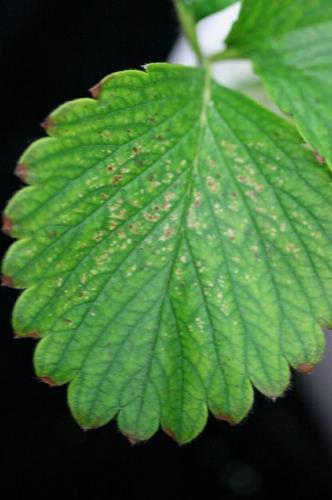
Potassium deficiency in strawberries usually first appears on the margins of mature leaves, causing browning, drying, and scorching symptoms that gradually move inward between the veins. As the deficiency becomes severe, leaf petioles become short and brittle, leaf bases may show necrosis, and the plant produces fewer and smaller fruits with poor color and texture, often accompanied by stunted growth and reduced shoot formation, all of which significantly impair yield and quality.
Kimat’s proposed solution:
Secondary macronutrient deficiency – Magnesium (Mg)
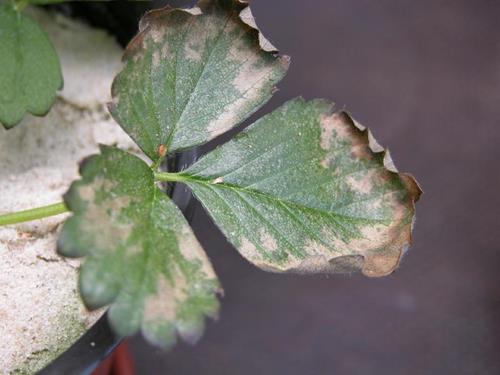
Magnesium deficiency in strawberries first appears in older leaves as interveinal chlorosis – yellowing between the veins – accompanied by leaf scorch and necrosis; as the deficiency progresses, the leaves turn light yellow with necrotic edges, while the broad base of the leaf remains green, and eventually the oldest leaves may turn completely brown and dry, while the younger central leaves often remain green.
Kimat’s proposed solution:
Secondary macronutrient deficiency – Calcium (Ca)
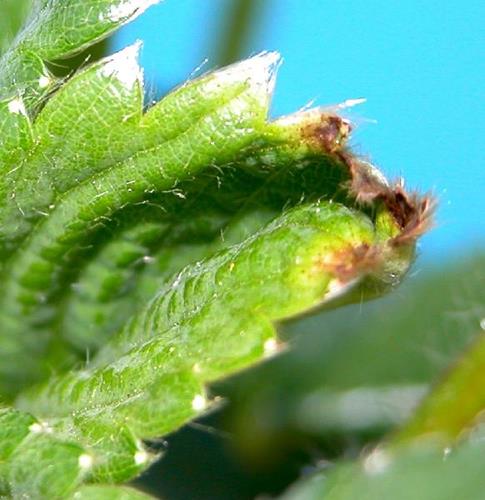
Calcium deficiency in strawberries primarily manifests as “leaf tip burn” on young, rapidly growing leaves in the center of the plant, where the leaf tips become brown and wrinkled due to the breakdown of cell walls and membranes. This causes irregular growth and the young leaves appear wrinkled or misshapen. Fruits may be smaller, with a hard texture and a dense seed coat at the fruit tip, sometimes leading to increased susceptibility to disorders such as blossom end rot and microbial infections. This deficiency is often linked to environmental factors such as low transpiration rates in cool, wet weather that limit calcium movement through the plant. Symptoms of calcium deficiency are distinguished from other nutrient deficiencies by browning on young, growing leaves and poor fruit development.
Kimat’s proposed solution:
Micro-B (boron) deficiency
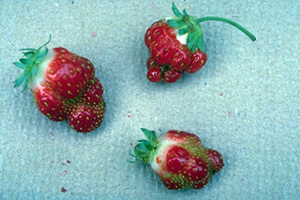
Boron deficiency in strawberries first appears as necrosis of the tips of young leaves, which become misshapen, often “square”, cupped and small. Plants are stunted and have many small lateral buds that do not develop properly. Fruits are misshapen due to poor fertilization, may crack before ripening and develop corky spots with a leathery texture. In severe cases, flowers are aborted, fruit formation is poor and overall yield is reduced. Root growth is also affected, resulting in short, brown lateral roots. Boron deficiency is often caused by limited availability due to high soil pH or leaching in sandy soils.
Kimat’s proposed solution:
Micro-element deficiency – Mn (manganese)
Manganese deficiency in strawberries is characterized by interveinal yellowing of young and mid-leaf leaves, while the veins remain green, resulting in a net-like appearance of the leaf. This condition is often caused by poor root growth or increased soil pH, and can lead to reduced plant vigor, reduced fruit size, and yield. It is best managed through foliar feeding with manganese sulfate or chelated manganese, along with close monitoring of soil pH.

Kimat’s proposed solution:
Micro-element deficiency – Fe (iron)
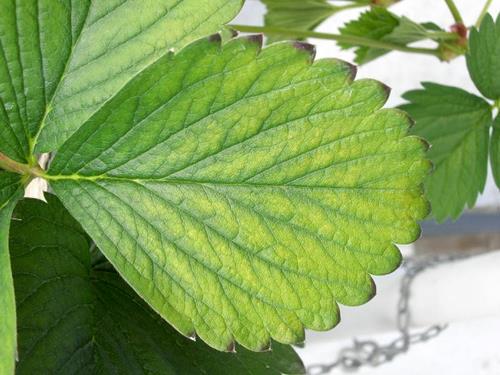
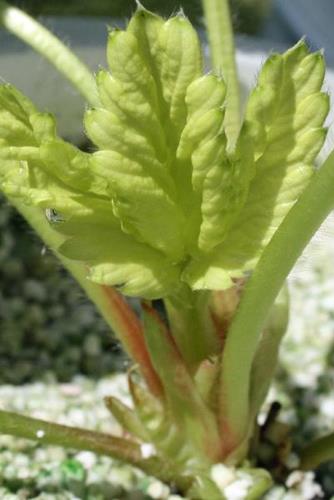
Iron deficiency in strawberries usually begins with yellowing (chlorosis) of the youngest leaves while the veins remain green, a condition known as interveinal chlorosis. As the deficiency progresses, affected leaves turn pale yellow to white and necrotic areas may develop at the leaf margins. Plant growth is stunted due to impaired chlorophyll synthesis and photosynthesis. Iron is immobile in plants, so deficiency symptoms first appear on new growth. This condition is usually caused by high soil pH (above 6.5), which limits iron availability.
 |
 |
Kimat’s proposed solution:

