



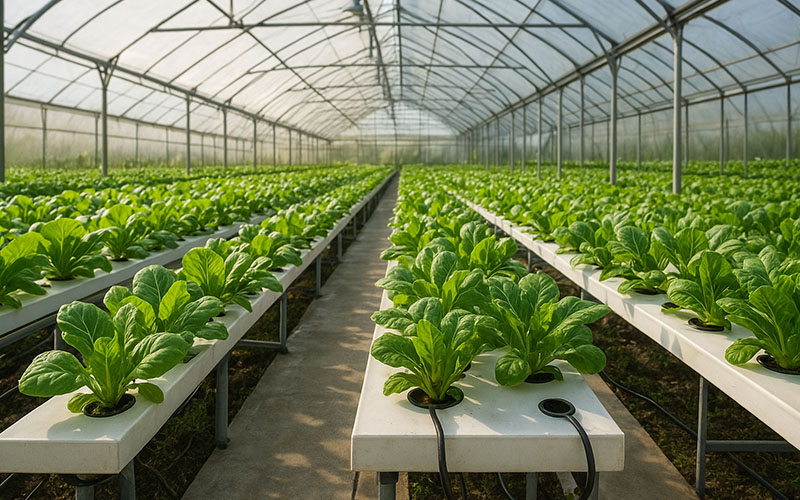
Modern agriculture: the future of food security
Modern agriculture refers to the use of advanced technologies, scientific innovations, and sustainable methods in agricultural production to increase productivity and efficiency. This approach uses technologies such as modern agriculture, including biotechnology methods, automated machinery, smart irrigation, and soil health, to use resources optimally and manage crops more effectively. Modern agriculture is important because it makes it possible to produce more food with fewer resources and helps ensure food security.
History of Hydroponics
Hydroponics is the cultivation of plants without soil using nutrient solutions, a process that dates back thousands of years but was formally developed in the early 20th century. Ancient examples include the Hanging Gardens of Babylon around 500-600 BC and the Aztec floating gardens, where water and nutrients supported plant growth. The first scientific reference to soilless cultivation was in Francis Bacon’s book “Sylva Sylvarum” in 1627. In the 19th century, researchers determined the mineral needs of plants, and the first formulas for nutrient solutions were developed by German scientists Julius von Sachs and Wilhelm Knopp in the 1860s.
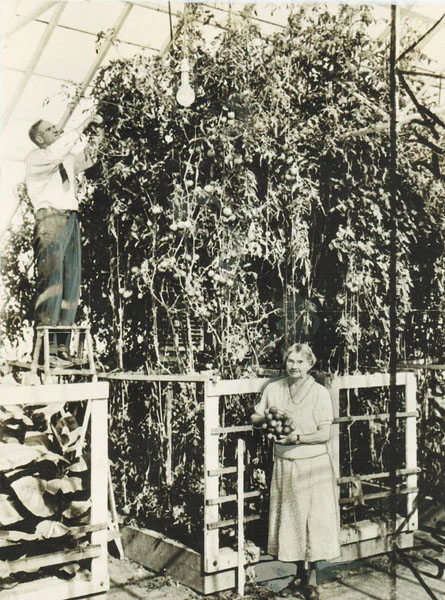
The foundations of modern hydroponics were laid in the late 1920s and 1930s by Dr. William Frederick Gericke at the University of California, Berkeley. Gericke coined the term “hydroponics.” His experiments, including growing tomatoes to heights of over 25 feet (7.5 m) in nutrient solutions, demonstrated the potential of soilless cultivation. These advances, along with the development of specialized systems and research in various fields of agriculture, led to hydroponics becoming recognized as a scientific and applied method in modern agriculture in the 20th century, and it is now used in a variety of climates and environments as a sustainable and efficient method.
What is hydroponics?
The word “hydroponics” comes from the Greek language and is a combination of the two Greek words “hydro” meaning water and “ponos” or “ponics/pono” meaning work or planting, so its literal meaning is “water cultivation”. Hydroponics is a method of growing plants without soil in which the plant receives all the nutrients it needs from an aqueous solution rich in mineral elements. In hydroponic systems, the plant roots are either directly exposed to nutrient-rich water or the plant roots grow in a growing medium such as perlite (Pellet), cocopeat (coconut fibre), rock wool (rock wool) or expanded clay grains (Clay Pellets). This method, by carefully controlling nutrients and environmental conditions, causes faster growth, less water consumption and increased productivity in agricultural production.
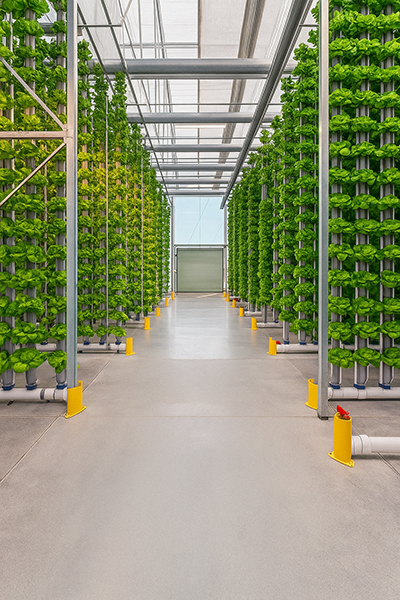
The scientific principles and foundations of hydroponics revolve around growing plants without soil by delivering a nutrient-rich aqueous solution directly to the roots. Key scientific concepts include:
Essential plant nutrients
Plants require 17 essential nutrients to grow and thrive, classified as macronutrients (such as nitrogen, phosphorus, potassium, calcium, magnesium, sulfur) and micronutrients (such as iron, manganese, zinc, boron, molybdenum, copper). In hydroponics, all of these nutrients are dissolved in water, allowing direct access to the roots without soil.
Nutrient solution and pH
The nutrient solution must be carefully balanced to provide all the minerals the plants need. Controlling the pH, ideally between 5.0 and 7.0, is very important because it affects the availability of nutrients and their absorption by the roots. The buffering capacity of the solution also affects the stability of the pH.
Oxygenation to the roots
Roots need adequate oxygen in the nutrient solution to effectively absorb nutrients and prevent rot. Systems use aeration techniques, such as air stones, to maintain dissolved oxygen levels.
Food interactions
Nutrient uptake can be affected by antagonism between nutrients, such that excess of one element inhibits uptake of another (for example, excess potassium can reduce nitrogen uptake). Proper formulation and monitoring will prevent deficiencies, despite adequate nutrient availability.
Systems Engineering
Hydroponic systems combine fluid dynamics and environmental controls to deliver water, nutrients, and oxygen to plant roots in a consistent and precise manner. Different types of systems, such as NFT, deep water cultivation, aeroponics, and drip systems, are each designed to optimize plant nutrition and growth in different conditions and crops.
Comparison of traditional (soil) and hydroponic cultivation:
Traditional soil cultivation and hydroponics differ fundamentally in how plants are fed, their resource consumption and growing conditions. In soil farming, the plant absorbs nutrients from the soil and its microorganisms, but in hydroponics, nutrients are delivered directly to the roots in water-soluble form, allowing for precise control of composition and pH. This method results in faster growth and higher yields.
In terms of resource consumption, hydroponics uses up to 90% less water because it has closed and recyclable systems, while traditional agriculture requires more space and some of the water is lost through evaporation and runoff.
In addition to higher productivity, hydroponics also has environmental benefits, as it reduces soil erosion and pesticide use, and can be applied even in areas with poor or shallow soil. In contrast, soil agriculture, if poorly managed, can lead to land degradation and reduced productivity.
Another important difference is the dependence on climatic conditions. Hydroponic systems are in a controlled environment and can be used year-round, but soil cultivation is usually dependent on the season and weather conditions.
Despite these advantages, hydroponics requires a higher initial investment in equipment and system control, while traditional farming has a lower initial cost and is more accessible to smaller farmers, although it requires more labor.
Ultimately, hydroponic crops are usually cleaner and more uniform, but the flavor and nutrient composition of soil plants is more diverse, as soil microorganisms play a role in the quality and flavor of the produce.
|
Aspect |
Traditional soil cultivation |
Hydroponic cultivation |
|
Source of nutrients |
Soil and organic matter |
Nutrient solution in water |
|
Water consumption |
High and low productivity |
Up to 90% less |
|
Land use |
Need more land |
Compact, can be used vertically |
|
Performance (yield) |
Less per square meter |
More, with faster growth |
|
Environmental impact |
Possibility of soil erosion and pollution |
Less, with lower chemical usage |
|
Seasonal dependence |
Depending on the season and climate |
Can be done all year round |
|
Type of products |
High diversity (including deep-rooted plants) |
More limited, more vegetables and leafy greens |
|
Maintenance and management |
Simpler but requires more labor |
More technical, capable of automation and precise control |
Types of hydroponic systems
Hydroponic systems are categorized based on the method of transporting the nutrient solution to the plant roots and the type of growing medium. The main types are:
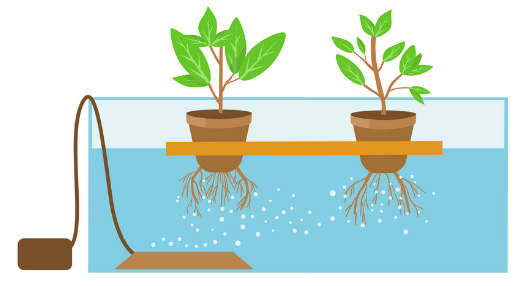
1. Deep water cultivation (Deep Water Culture – DWC)
In this method, plants are positioned so that their roots are directly immersed in a nutrient- and oxygen-rich water solution. This system is suitable for leafy greens and aromatic plants and is easy to set up and manage.
2. Nutrient Film Technique (NFT)
In this method, a thin stream of nutrient solution moves continuously through inclined channels and passes around the roots. This system is very suitable for fast-growing plants with small roots, such as leafy vegetables.
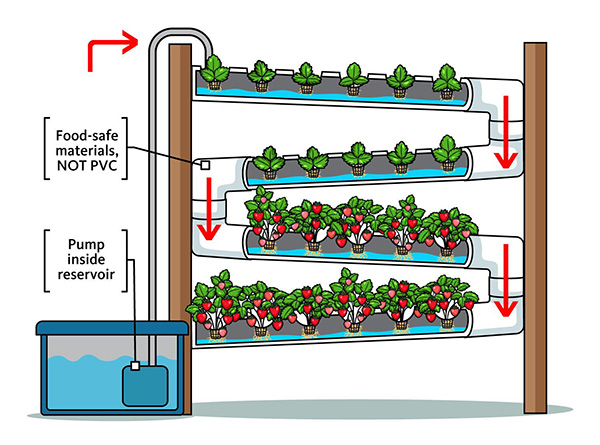
3. Ebb and Flow / Flood and Drain System
In this method, the culture trays are periodically filled (submerged) and then emptied (drained) with nutrient solution. This regular cycle allows for better oxygenation of the roots and efficient nutrient uptake.
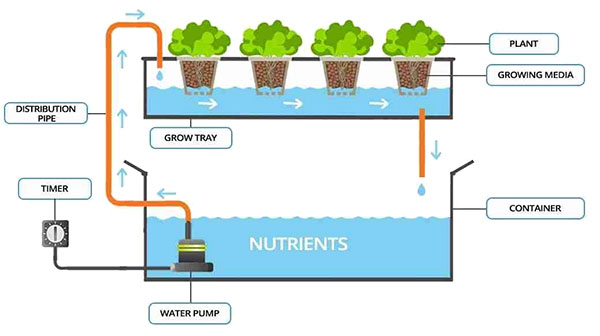
4. Drip System
In this system, a pump delivers nutrient solution through pipes and drippers directly to the root zone of each plant. This method can be closed (circulating) or open (with effluent) and is widely used for growing vegetables, fruits, and ornamental plants.
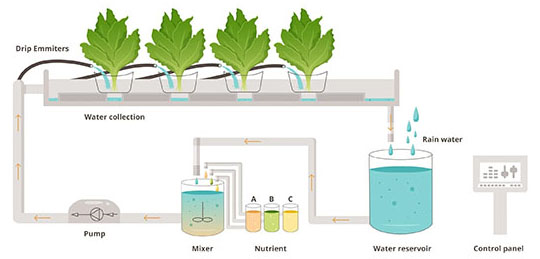
5. Wick System
In this passive system, the nutrient solution is transferred from the tank to the plant roots using a wick (cotton or nylon rope). This method is simple and does not require a pump or timer, and is suitable for small plants or those with low nutrient requirements.
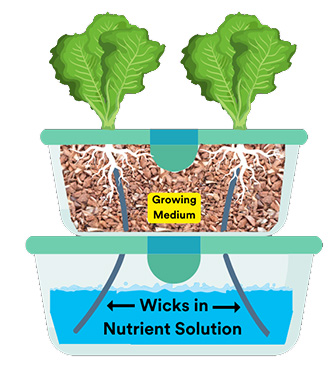
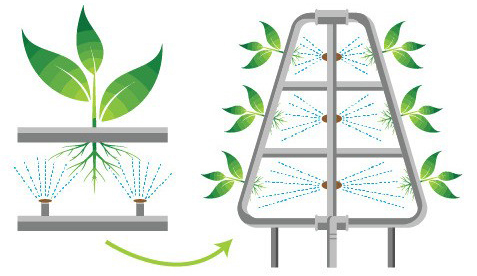
6. Aeroponics
In this method, the roots of the plants are suspended in the air and regularly misted with a nutrient solution. Due to the high oxygen supply, plant growth is rapid and this system is applicable to a wide range of crops, especially in the propagation stage.
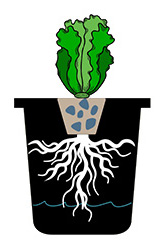
7. Kratky Method
This method is a passive, non-circulating system in which the plant is placed above a tank containing a stagnant nutrient solution. This method is very simple and low-cost and is suitable for small-scale leafy vegetable production.
Nutrition system in hydroponics
In hydroponic systems, the plant nutrition part is based on the preparation and management of a nutrient solution. This solution provides all the elements necessary for plant growth without the need for soil. In effect, the nutrient solution acts as the “soil” and enables growth by delivering water and dissolved substances directly to the plant’s roots.
Composition of nutrient solution in hydroponics
Macronutrients
These elements are required by plants in large quantities and include nitrogen (N), phosphorus (P), potassium (K), calcium (Ca), magnesium (Mg), and sulfur (S).
Nitrogen: Essential for protein synthesis and vegetative growth.
Phosphorus: Plays a role in energy transfer and root growth.
Potassium: Regulates water balance and enzyme activity.
Calcium: Strengthens cell walls.
Magnesium: It is the main element in the structure of chlorophyll.
Sulfur: Plays a role in the formation of amino acids and proteins.
Trace elements (micro)
These elements are required in small amounts but are crucial for the vital functioning of the plant, including: Iron (Fe), Manganese (Mn), Zinc (Zn), Copper (Cu), Boron (B), Molybdenum (Mo) and Chlorine (Cl)
Preparing the nutrient solution
- To prevent contamination and disruption of nutrient absorption, pure or purified water is used.
- Mineral salts such as calcium nitrate, potassium nitrate, magnesium sulfate, and micronutrient compounds dissolve in water.
- The solution formula can be adjusted depending on the type of plant or growth stage. Common formulas include Hoagland Solution or custom blends.
- pH management is critical. The ideal range is usually between 5.5 and 5.0 for most hydroponic plants for optimal nutrient uptake.
- Electrical conductivity (EC) is an indicator of the concentration of dissolved substances and should be checked regularly. EC levels may change during different stages of growth.
System power management
As the plant absorbs elements, the concentration of nutrients in the solution decreases. Therefore, regular measurement and adjustment of nutrient levels and pH is essential. A balanced supply of nutrients prevents deficiency or toxicity symptoms and improves plant growth, performance and health. In most hydroponic systems, the nutrient solution is used in a rotational manner to save water and reduce waste, but the solution must be replaced or renewed at regular intervals to maintain the desired nutrient concentration.
Conclusion:
Hydroponics is a highly efficient and sustainable method of growing plants, delivering nutrients directly to the roots in a controlled, soil-free environment. It uses up to 90% less water than traditional farming, uses space compactly and vertically, and allows for year-round production regardless of weather conditions. Eliminating soil in this system reduces the risk of soil-borne pests and diseases, and allows for precise management of plant nutrition for better health and higher yields. It also minimizes environmental impacts by reducing chemical use and preventing soil erosion. The combination of these benefits results in increased yields, faster growth, and more efficient use of resources, making hydroponics an ideal solution for modern agriculture, especially in urban or resource-limited areas.