


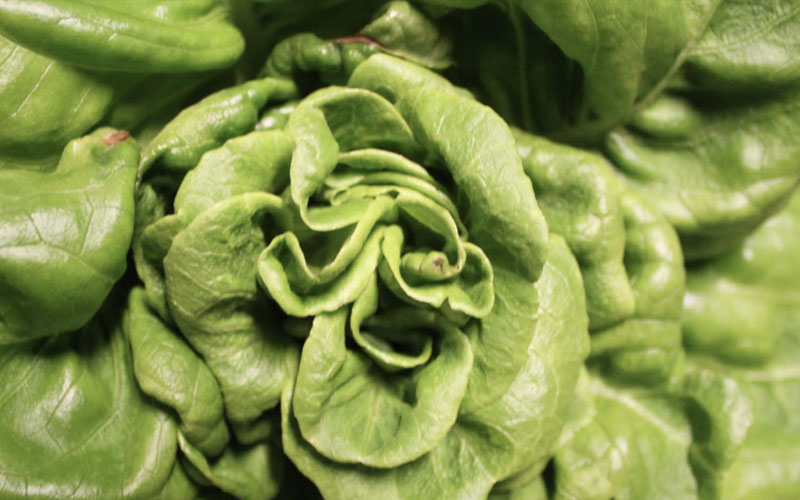
Nutrient deficiencies in lettuce are of great importance because they compromise growth, yield, and leaf quality, leading to symptoms such as stunting, chlorosis, browning, and leaf tip scorch, which not only reduce market value but also affect nutritional content and food safety; therefore, effective nutrient management, especially nitrogen, phosphorus, potassium, and calcium, is essential to ensure robust plant health, optimize production, and prevent economic losses for growers, while ensuring that the resulting lettuce is safe and nutritious for consumers.
Macro-N (nitrogen) deficiency
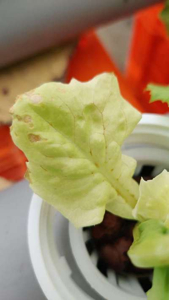
Nitrogen deficiency in lettuce first appears as light green to yellow chlorosis in older leaves, which gradually spreads throughout the plant, eventually causing the entire head to turn yellow-green, limiting growth and development. Severe nitrogen deficiency results in stunted plant growth, delayed maturity, and in severe cases, failure to form heads. While leaf shape generally remains normal, older leaves may become stunted and roots tend to grow longer with fewer secondary roots. This deficiency is often confused with magnesium, sulfur, or manganese deficiencies, but specific nitrogen symptoms include uniform yellowing that begins with older foliage and results in a significant reduction in yield and marketable quality.
Kimat’s proposed solution:
Macro-P (phosphorus) deficiency
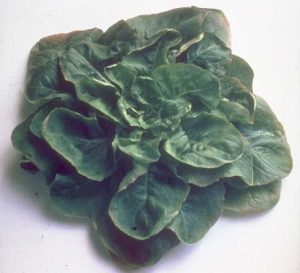
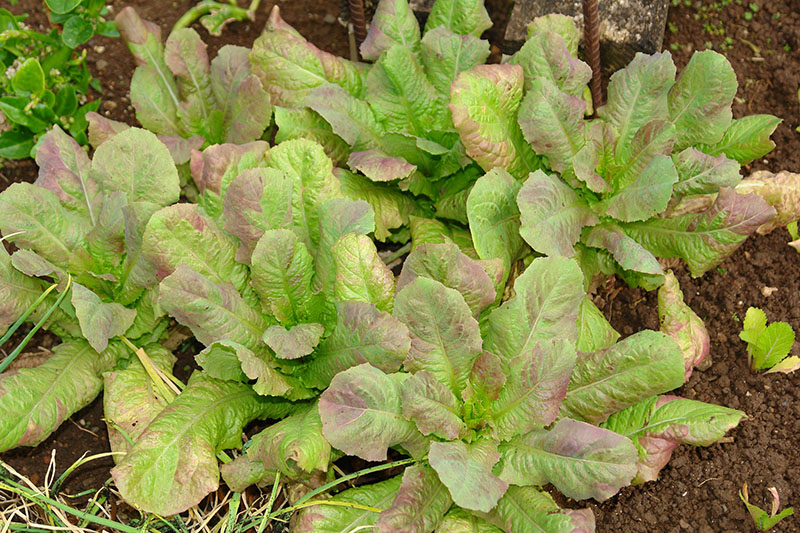
Phosphorus deficiency in lettuce results in stunted growth, delayed or absent head emergence (rosetting) and severe yield reduction, with leaves becoming a darker green colour. Sometimes a purplish or reddish blush develops if anthocyanins are present, and as symptoms progress, papery necrotic areas develop and shrivel; roots may show secondary stunting and sometimes a reddish discolouration, and older leaves eventually die, while low soil temperatures can exacerbate the deficiency by limiting phosphorus uptake.
 |
 |
Kimat’s proposed solution:
Macro-K (Potassium) deficiency
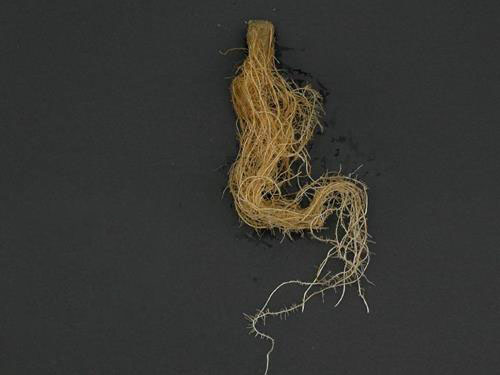
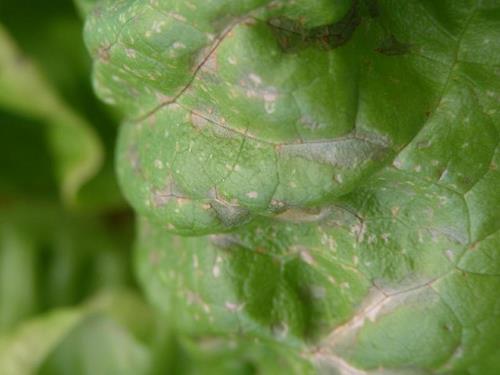
Potassium deficiency in lettuce is characterized by chlorotic and necrotic spots at the tips and margins of older leaves, scorched leaf edges, and leaf deformation, which in severe cases results in a mottled dark green color, wilting, wrinkling, and reduced leaf roundness, and stunted growth, resulting in loose or misshapen heads. The deficiency also causes longer, slimy taproots with fewer secondary roots, and affected plants show poor disease resistance and reduced yield quality. Symptoms of potassium deficiency can be confused with high salinity in the soil, but the most obvious symptoms are browning and drying along the leaf margins, accompanied by poor growth and reduced shelf life.
 |
 |
Kimat’s proposed solution:
Secondary macronutrient deficiency – Magnesium (Mg)
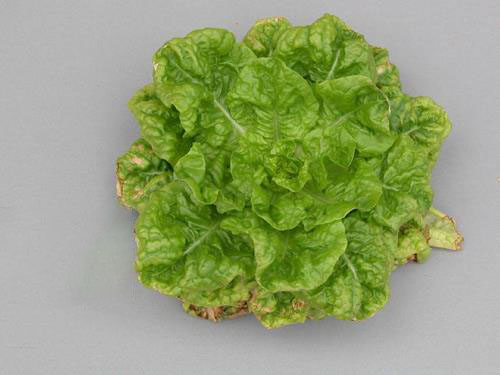
Magnesium deficiency in lettuce usually first appears in older leaves as interveinal chlorosis, in which the leaf tissue between the veins turns yellow or orange while the veins themselves remain green, often accompanied by upward curling of the interveinal areas. As the deficiency progresses, the yellow areas may become necrotic but the veins remain green and overall growth is only slightly restricted at moderate levels and severely inhibited in severe deficiency. Roots under magnesium deficiency are usually long with few secondary roots and the symptom pattern can be confused with manganese deficiency, although magnesium deficiency usually shows more orange-yellow discoloration between the veins compared to the greener and yellower pattern of manganese deficiency.
Kimat’s proposed solution:
Secondary macronutrient deficiency – Calcium (Ca)
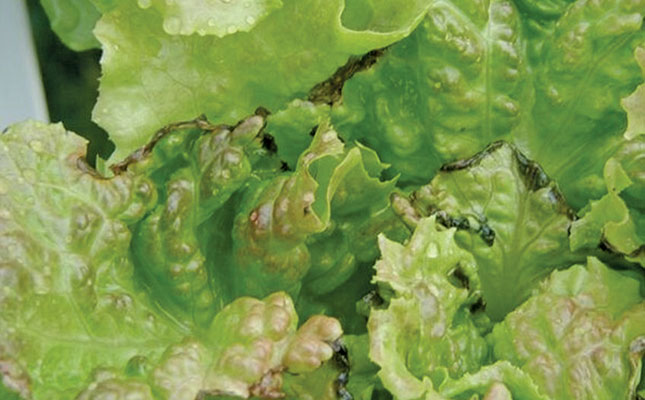
Calcium deficiency in lettuce mainly manifests as leaf tip burn, which is characterized by brown or gray lesions on the margins and tips of young leaves that gradually spread inward, causing the affected leaf tissue to die. This results in stunted growth, curling of the leaves and their darkening to a dark green color, and in severe cases, failure to form a leaf tip. This deficiency often affects rapidly growing tissues because calcium is immobile in the plant and moves primarily by transpiration, so low transpiration rates due to high humidity or water stress limit the supply of calcium to the plant. In roots, calcium deficiency causes them to be short, highly branched, brown, sometimes slimy, and have black tips. Leaf tip burn is usually not due to a lack of calcium in the soil, but rather to impaired calcium transport to young tissues, since calcium is essential for cell wall integrity and tissue strength.
Kimat’s proposed solution:
Secondary macronutrient deficiency – sulfur (S)
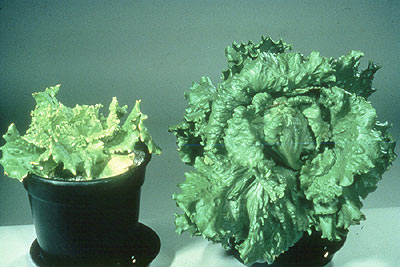
Sulfur deficiency in lettuce causes uniform yellow-green chlorosis that begins in the youngest leaves and gradually affects the entire plant, resulting in reduced growth and a pale, light green or yellow appearance throughout the plant. Roots become highly branched, longer than normal, and turn white. Symptoms of sulfur deficiency can be similar to nitrogen deficiency but usually begin in younger leaves rather than older leaves, and the deficiency is more severe in light, acidic sandy soils with little organic matter or poor aeration. Since sulfur is essential for healthy green foliage and important metabolic functions, its deficiency clearly limits plant growth and development.
Kimat’s proposed solution:
Micro-element deficiency – Mn (manganese)
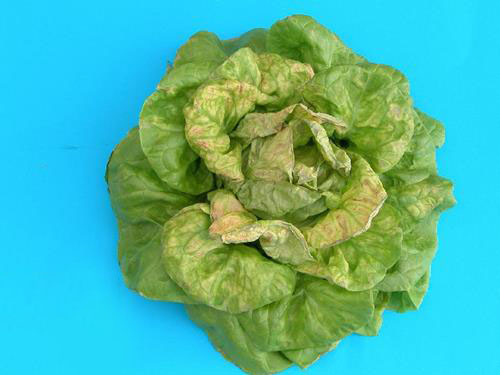
Manganese deficiency in lettuce causes the entire plant to turn a greenish-yellow color while the leaf veins often remain a darker green, creating a mosaic pattern; in severe deficiency, necrotic spots develop on the margins and between the veins of older leaves, but overall head growth is not severely affected. This deficiency can be confused with nitrogen, sulfur, or magnesium deficiency, but manganese deficiency is usually shown by the veins remaining green and the interveinal areas turning yellow, with the yellow color tending to be greenish-yellow rather than the orange-yellow seen in magnesium deficiency.
Kimat’s proposed solution:
Deficiency of microelements – Cu (copper)
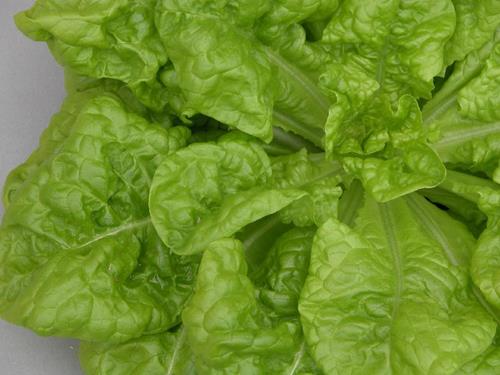
Copper deficiency in lettuce causes plants to appear wilted and limp, and chlorotic spots along the tips and margins of leaves progress from older leaves to younger leaves. Gray-brown necrotic areas develop in these chlorotic areas, the leaves turn yellow, wilt, and sometimes show a bright red or pink discoloration of the veins. This deficiency results in stunted growth, the production of small, light clusters, and in severe cases, no clusters at all. Root development is slightly restricted, and secondary roots become long, thin, and white. Symptoms of copper deficiency in hydroponic lettuce production are rare, but should be confirmed by leaf tissue analysis before treatment.
Kimat’s proposed solution:
Micro-element deficiency – Mo (molybdenum)
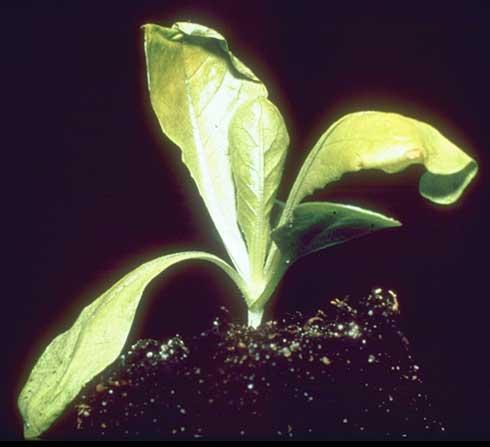
Molybdenum deficiency in lettuce causes stunted growth with pale green leaves that develop clear spots in the interveinal areas that later become necrotic and develop into larger dead areas. Leaves begin to wilt from the tips and margins, and the tissue dies and shows a brown-yellow discoloration. This deficiency is often exacerbated by low soil pH and may be confused with calcium deficiency, but unlike calcium deficiency, lettuce leaves with molybdenum deficiency are softer and paler, and are not wrinkled and dark green. Molybdenum is essential for nitrate reduction and protein synthesis, so its deficiency results in poor growth and development.
Kimat’s proposed solution: