


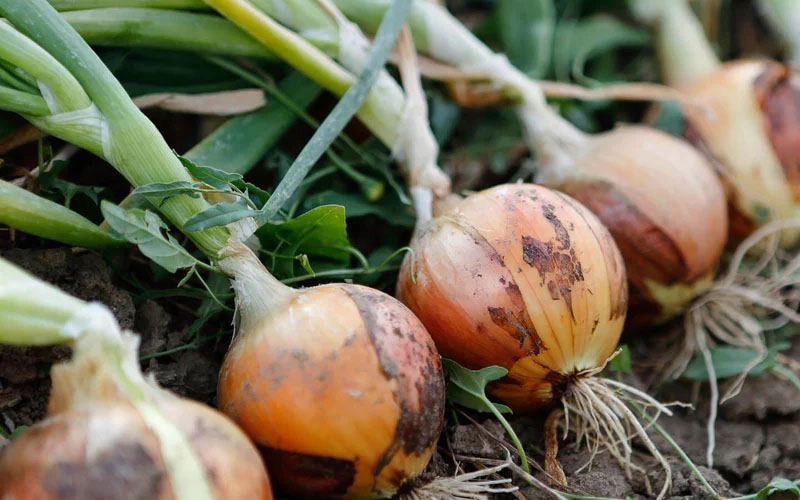
Nutrient deficiencies in onions are of great importance because they directly reduce onion growth, yield, and quality, causing symptoms such as stunted growth, yellowing of leaves, and premature wilting of onions. They can also reduce storability, increase susceptibility to diseases, and ultimately lead to significant financial losses for farmers due to poor crop performance and reduced market value.
Preventing nutrient deficiencies in onions requires regular soil testing to identify deficiencies, using balanced fertilizers based on crop stage (primary nitrogen, phosphorus for root and bulb growth, potassium for disease resistance, sulfur for flavor), appropriate use of organic matter or mineral fertilizers, including micronutrients such as magnesium, boron, and zinc as needed, observing crop rotation and removing plant debris to reduce disease risk, and considering beneficial microbes such as phosphorus-solubilizing bacteria or mycorrhizal fungi to increase nutrient availability and root uptake efficiency.
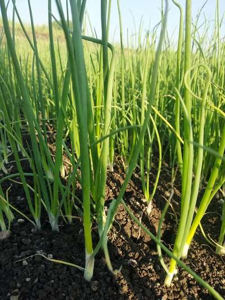
Macro-N (nitrogen) deficiency
Nitrogen deficiency in onions leads to stunted growth, premature maturation, and uniform leaf discoloration from pale green to yellow, with symptoms starting in older leaves and moving toward the center of the plant in severe deficiency; leaves become smaller, thinner, and straighter, often accompanied by wilting of leaf tips, resulting in smaller bulbs and reduced yield, especially if the deficiency is prolonged or severe.
Kimat’s proposed solution:
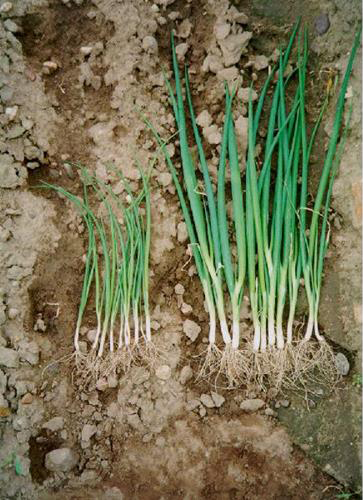
Macro-P (phosphorus) deficiency
Phosphorus deficiency in onions results in poor growth and stunted growth, delayed establishment, and severe effects on root development. Early symptoms include dull blue-green or dark green leaves, wilting and drying of leaf tips without obvious yellowing, and eventually blackening of dead tissue; plants often show thick stems, slow maturation, and an overall reduction in bulb size and yield, especially when the soil is cool, poorly drained, or alkaline.
Kimat’s proposed solution:
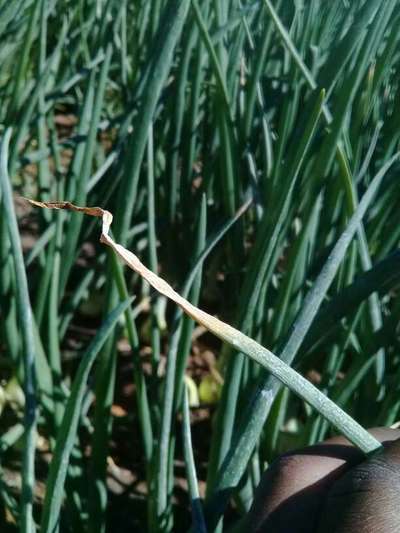
Macro-K (Potassium) deficiency
Potassium deficiency in onions causes older leaves to dry out from the tips without first turning yellow, the leaf margins to appear brown or burnt, and the leaf edges to curl or wilt. In long-term cases, necrosis spreads to the base of the leaf, possibly leading to plant death. Leaves may also become dark green and flat with signs of tip burn, and potassium deficiency can result in stunted growth, weak stems, increased susceptibility to disease and environmental stresses, and poor bulb growth or size.
Kimat’s proposed solution:
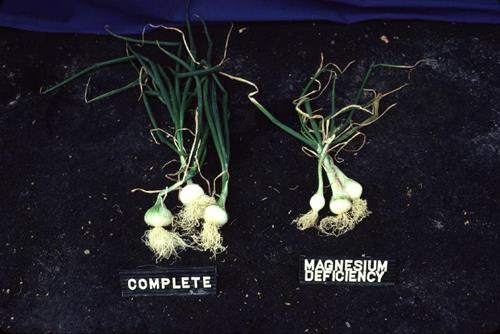
Secondary macronutrient deficiency – Magnesium (Mg)
Magnesium deficiency in onions causes older leaves to turn yellow uniformly along their entire length due to the loss of chlorophyll, without the usual leaf tip wilting initially, followed by browning and wilting of the leaf tips as the deficiency progresses. This deficiency leads to stunted growth and reduced overall plant vigor. Magnesium is essential for efficient chlorophyll production and photosynthesis, so magnesium deficiency impairs energy production and can reduce onion yield and quality, especially in sandy, acidic soils or soils with high potassium levels where magnesium uptake is difficult.
Kimat’s proposed solution:
Deficiency of microelements – Cu (copper)
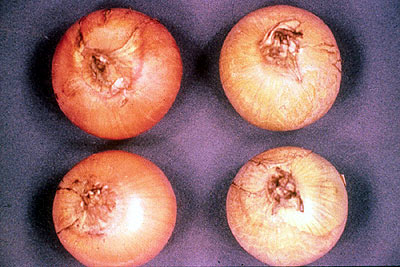
Copper deficiency in onions is manifested by the whitening of young leaf tips, twisting in a spiral or bending at right angles, followed by chlorosis and drying of the onion. The deficiency also causes the onion scales to become soft, pale yellow and thin, affecting the quality and keeping quality of the onion. This deficiency is more common in organic, peaty or sandy soils with high pH and is often exacerbated by high nitrogen applications. Copper is essential for photosynthesis, enzyme function and onion skin development, so its deficiency reduces the vigor of the crop and its marketability.
Kimat’s proposed solution:
Micro-element deficiency – Fe (iron)
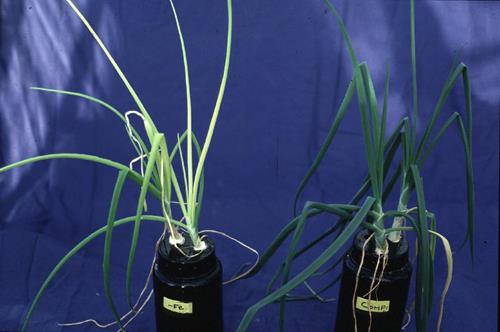
Iron deficiency in onions usually manifests as interveinal yellowing of the youngest leaves, and in severe cases, it progresses to a general yellowing of the leaf and eventually complete bleaching of the tissue. Since iron is relatively immobile in the plant, deficiency symptoms first appear on new growth. This deficiency impairs chlorophyll production and reduces photosynthesis, leading to stunted growth and weaker plants. This deficiency is usually associated with calcareous or high pH soils and waterlogged or anaerobic conditions that limit iron availability.
Kimat’s proposed solution:
Micro-element deficiency – Fe (iron)
Iron deficiency in onions usually manifests as interveinal yellowing of the youngest leaves, and in severe cases, it progresses to a general yellowing of the leaf and eventually complete bleaching of the tissue. Since iron is relatively immobile in the plant, deficiency symptoms first appear on new growth. This deficiency impairs chlorophyll production and reduces photosynthesis, leading to stunted growth and weaker plants. This deficiency is usually associated with calcareous or high pH soils and waterlogged or anaerobic conditions that limit iron availability.